Milton's Socratic Rationalism by David Oliver Davies
Author:David Oliver Davies
Language: eng
Format: epub
Publisher: Lexington Books, a division of Rowman & Littlefield Publishers, Inc.
Chapter 4
An Interlude
A Question of Ends
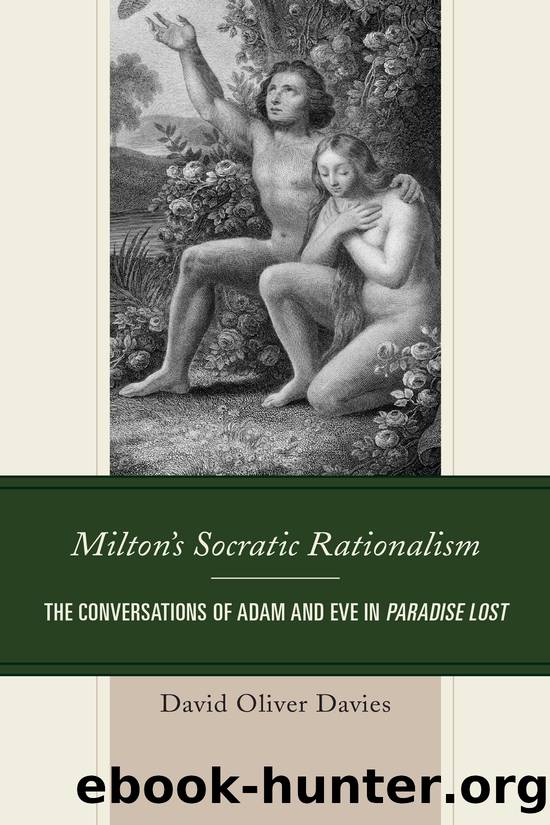
There is reason to think that Adam would have been both pleased and yet at a loss for what to say to Eve when, days after they first met, she now began to speak with him. Only now did it seem the promise of the Divine PresenceââWhat next I bring shall please thee, be assured\ Thy likeness, thy fit help, the other self,\ Thy wish, exactly to thy heartâs desireâ (8.449â451)ââmight be fulfilled. Adam, as he later told Raphael, had spoken to that Presence of his âsingle imperfectionâ that was âthe cause of his desire\ By conversation with his like to help,\ Or solace his defectsâ (8.417â419). But when, after his dream-induced desireâseeing his own flesh and bone taken then rendered in such a lovely formâbegan to dissipate, he gradually began to think that this was not after all what he had asked for.1 So Eve herself had occasion to note (4.447â448). But now she was talking, but what was she talking about? For the moment âin delight\ Both of her Beauty and submissive Charmsâ (4.497â498) he merely smiles.
With the touch of Adamâs hand the day they met Eve had more reason to be pleased and grateful to that Power that Adam tells her made them both. But that granted, Eveâs talk just now was all about Adam. Her talk of herself, and of âThat day I oft rememberâ (4.449), was intended to offer solace to Adam by the example of her own brief experience of him several days before. She too had sought a âlike consortâ to herself. She as well had had her fair hopes raised by a voice at the pool only to be at first disappointed. But now, days later, she reminds him of the appeal he had made to her: âto have thee by my side\ Henceforth an individual solace dear;\ Part of my soul I seek theeâ (4.485â487). And with that touch of his hand, she tells him, these words of his were fulfilled for her. The voice at the pool that day had spoken of, âhe\ Whose image thou artâ (4.471â472). Now several days later, Eve tries to show Adam a likeness of his yearning in herself which he that day had satisfied.
To judge, however, from the sense narrative persona imposes on these events Adam does not as yet grasp what Eve has told him. Adam surely understands her acceptance of him, but the mode of reasoning would be strange. Eve revalued the âfairâ by the âtruly fair.â As she tells him, âand from that time [I] see\ How beauty is excelled by manly grace\ And wisdom, which alone is truly fairâ (4.489â491). But as she now âhalf imbracing lean[s] \ On our first Fatherâ (4.494)ââher proffered analogue at this moment to Adamâs clasp of her hand that dayâânarrative persona now reads this gesture as of amorous intent and thinks of Jupiterâs âsuperior Loveâ (4. 499) of Juno.
Here Milton conveys Adamâs confused appreciation of Eve through the lens of his narratorâs confusion about Adam.
Download
This site does not store any files on its server. We only index and link to content provided by other sites. Please contact the content providers to delete copyright contents if any and email us, we'll remove relevant links or contents immediately.
| Anthropology | Archaeology |
| Philosophy | Politics & Government |
| Social Sciences | Sociology |
| Women's Studies |
Born to Run: by Christopher McDougall(7127)
The Leavers by Lisa Ko(6948)
iGen by Jean M. Twenge(5416)
Sapiens by Yuval Noah Harari(5372)
Spare by Prince Harry The Duke of Sussex(5197)
The Kite Runner by Khaled Hosseini(5180)
Machine Learning at Scale with H2O by Gregory Keys | David Whiting(4313)
Bullshit Jobs by David Graeber(4191)
Never by Ken Follett(3957)
Goodbye Paradise(3810)
Livewired by David Eagleman(3775)
Fairy Tale by Stephen King(3399)
A Dictionary of Sociology by Unknown(3085)
Harry Potter 4 - Harry Potter and The Goblet of Fire by J.K.Rowling(3074)
The Social Psychology of Inequality by Unknown(3031)
The Club by A.L. Brooks(2926)
Will by Will Smith(2920)
0041152001443424520 .pdf by Unknown(2846)
People of the Earth: An Introduction to World Prehistory by Dr. Brian Fagan & Nadia Durrani(2739)
